
The ball: dots and technical requirements
Double yellow denotes the competition category, single yellow the club category and green the high-altitude category. The three standard types share dimensions and mass but have different rebound requirements.
On this page
Size, mass and strengthWhat do the dots mean?Rebound percentages in the standard testBeginners and improversCompetition ballsFrequently asked questionsSize, mass and strength
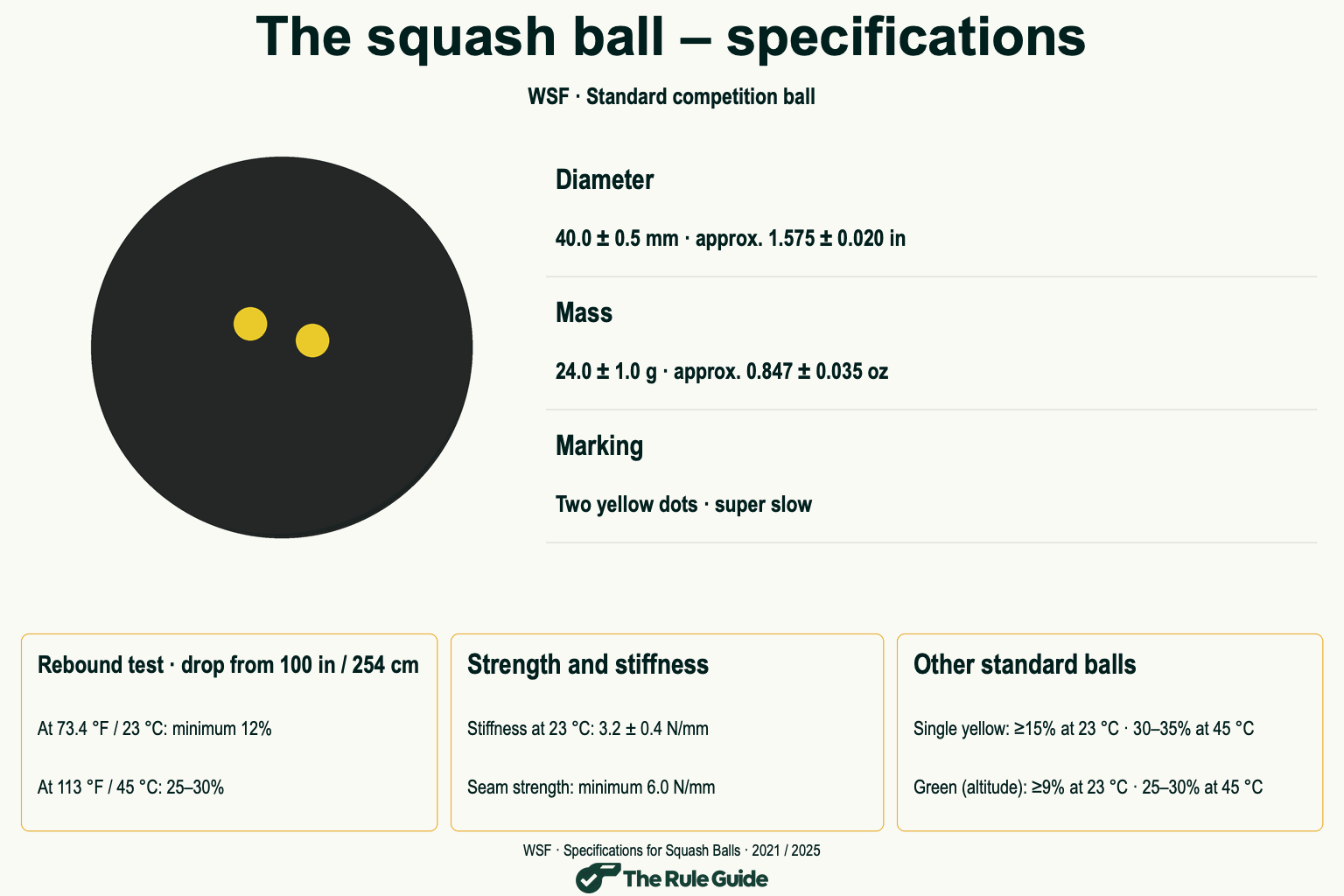
Standard competition, club and high-altitude balls have a diameter of 40.0 ±0.5 mm and mass of 24.0 ±1.0 g. Stiffness at 23 °C is 3.2 ±0.4 N/mm; seam strength is at least 6.0 N/mm. These are technical test values, not instructions for a home test.
The same diameter, mass, stiffness and seam-strength requirements apply to the three specified yellow- and green-dot categories; their rebound requirements differ. The stiffness is a force-per-displacement measurement, not a pressure to inflate the ball to.
What do the dots mean?
Double yellow and green indicate super slow; green is specifically for high-altitude play. Single yellow is slow, red medium and blue fast. Red and blue balls may exceed 40 mm in diameter, so not every training ball has the same size.
Rebound percentages in the standard test
The test drop height is 254 cm. At 23 °C the minima are 12% for double yellow, 15% for single yellow and 9% for green. At 45 °C the respective ranges are 25–30%, 30–35% and 25–30%. These percentages refer to the test drop height; temperature is part of the test conditions.
Rebound figures are percentages of the 254 cm drop height under controlled temperature conditions. A 25% rebound corresponds to 63.5 cm in that test. Comparing a cold ball’s bounce with a warm ball without controlling temperature is not a valid compliance comparison.
Beginners and improvers
Recommended beginner rebound values are at least 17% at 23 °C and 36–38% at 45 °C. For improvers they are at least 15% and 33–36%. Faster balls may differ in diameter and mass. Choice depends on ability and court conditions; double yellow is not automatically suitable for everyone.
Competition balls
World Championships and comparable levels require the double-yellow competition specification. Additional suitability assessment may apply. Organisers may authorise larger yellow-dot balls that otherwise meet the specification.
Approval for a larger yellow-dot tournament ball requires the organising body’s authorisation; players cannot substitute one merely because it has a yellow dot. Championship suitability may also include assessment by players of the relevant standard, beyond dimensional tests.
Frequently asked questions
Which squash ball should a beginner use?
A faster ball suited to ability and court conditions is generally appropriate. Blue denotes fast, red medium, single yellow slow and double yellow super slow; green is a high-altitude super-slow ball. Double yellow is not automatically the right choice for a beginner.
Are all squash balls the same size?
No. The specified double-yellow, single-yellow and green categories have a 40.0 ±0.5 mm diameter. Faster training balls may differ, and authorised larger yellow-dot balls can be used in particular tournaments.