
The court: dimensions and layout
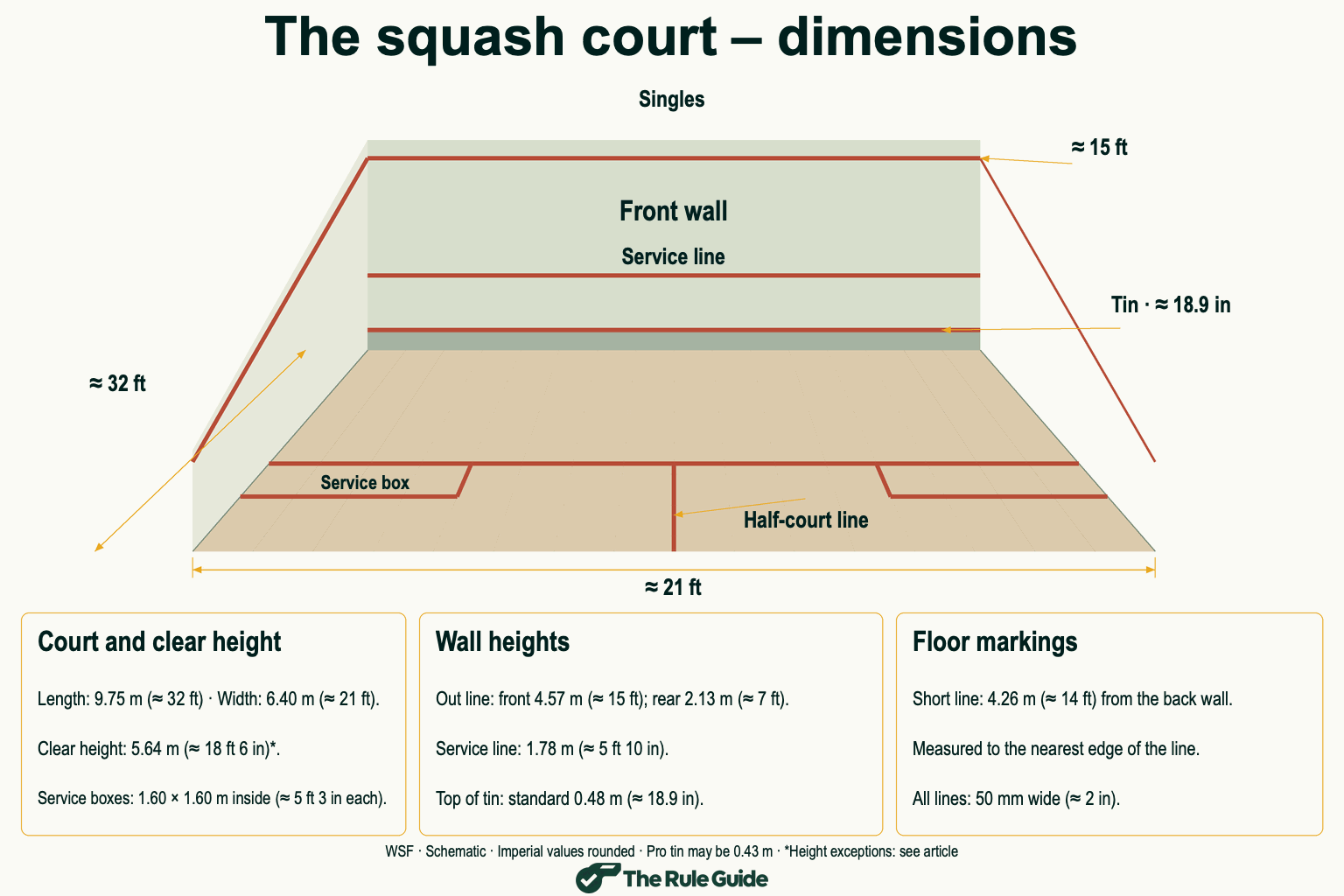
A standard singles court measures 9.75 × 6.40 m. The technical specification covers markings, the tin, clear height and playing conditions; doubles uses different court widths.
On this page
Dimensions and measurementWall lines and tinFloor markings and service boxesClear height and safe constructionLighting, temperature and ventilationDoubles courts and playing formatsFrequently asked questionsDimensions and measurement
Measure between the finished wall playing surfaces at 1 m above the floor: length 9.75 m and width 6.40 m, each with a tolerance of ±10 mm. The diagonal is 11.665 m ±20 mm. The court has four vertical walls and a level floor.
Dimension tolerances apply to the finished playing surfaces, not the outside of a building shell. In an existing deteriorated court renovated with a lining system, the recommendation is not to reduce plan dimensions by more than 80 mm; this is a specific renovation allowance, not a normal new-court size.
Wall lines and tin
The lower edge of the out line is 4.57 m high on the front wall and 2.13 m on the back wall. The side-wall line slopes between them. The service line’s lower edge is 1.78 m high; the standard tin is 0.48 m. Professional event requirements may use a 0.43 m tin; confirm the event’s configuration.
Wall heights are measured to the underside of the lines, while tin height is measured to its top. Markings may deviate by at most 5 mm from their stated position, with the tin limited to 2 mm. The service line must not deflect the ball; the tin should make a distinct sound when hit.
A transparent back wall exactly 2.13 m high need not carry a back-wall line. At 2.18 m or higher, the line is marked on its court face. The side boundaries still join the front boundary to the actual or imaginary back-wall boundary.
Floor markings and service boxes
All lines are 50 mm wide. The nearest edge of the short line is 4.26 m from the back wall. The half-court line runs from the back wall to the short line. Service boxes sit behind the short line against the side walls and measure 1.60 × 1.60 m internally. Floor markings must be flush and slip-resistant.
Wall and floor lines must contrast with their surroundings. Wall lines share one colour and floor lines share one colour, but those two colours need not match. Line straightness is within 2 mm over 3 m.
Clear height and safe construction
The basic clear-height dimension is 5.64 m, free of lights and other obstructions. Only the gradual reductions near the front and rear walls shown in diagram 5 are allowed: from 1 m away from the front wall towards 5 m high, and from 3 m away from the back wall towards 4 m high. The floor must be hard, level, clean and slip-resistant; walls must be safe and give consistent rebound. The door opens inward and closes flush with the wall.
Walls must be smooth, hard and provide consistent rebound, without unsafe projections at corners or floor junctions. Transparent walls need tested safety material and must also meet rebound and friction requirements. Movable walls must meet the same playing requirements when fixed.
The entrance belongs in the middle third of the court, preferably centred in the back wall. Its handle must be flush and its latch must resist opening when a player strikes it. The normal door is 750–900 mm wide and 2,130 mm high; assessed accessible designs may be wider.
The floor must provide firm footing with limited spring and no distortion of a ball’s line on bouncing. It must absorb small amounts of moisture without becoming slippery or have a tested slip-resistant surface. Dust, rubber deposits and other material that reduce grip must be removed.
Lighting, temperature and ventilation
Lighting measured 1 m above the floor must reach at least 300 lux; 500 lux is recommended, or 600 lux for LED installations. Avoid shadows, glare and visible flicker. Recommended temperature is 15–25 °C, ideally 18–20 °C. Provide at least four complete air changes per hour during use and prevent condensation.
Illumination should be even: local levels must stay within 15% of the average. At least six LED fittings for singles and eight for doubles are recommended for distribution. Broadcast lighting is assessed separately; 1,200 lux is a suggested minimum, not the ordinary club-court requirement.
Cameras, lights and ventilation must not intrude into the required clear height or distract players. Front-wall equipment above the playing surface is permitted only within the restricted overhead area, at least 5 m high, projecting at most 150 mm and casting no front-wall shadows.
Doubles courts and playing formats
International doubles configurations include 9.75 × 7.62 m with a 0.48 m tin, and competition-width doubles at 9.75 × 8.42 m with a 0.33 m tin. These are distinct from singles and hardball doubles. Court construction and accreditation require more than checking these headline dimensions.
A doubles court is not a singles court unless a movable side wall can reduce it to the 6.40 m singles width. Competition-width doubles uses an 8.42 m width and 0.33 m tin; the 7.62 m version uses a 0.48 m tin. Hardball doubles is a separate, longer-court game.
Frequently asked questions
Are singles and doubles squash courts the same width?
No. Singles is 6.40 m wide. International doubles configurations are 7.62 m or 8.42 m wide, with different tin heights. A wider court needs a movable wall set to singles width to become a singles court.
Is the tin always 48 cm high?
The ordinary singles dimension is 48 cm. Professional events may use 43 cm, and competition-width doubles uses 33 cm. Check the event configuration rather than treating one height as universal.