
Balls, caps, goals and equipment
Men’s and women’s balls share a weight range of 400–450 g. They differ in circumference and inflation pressure.
On this page
1. Ball and cap2. Goals and deck3. Caps and match clothing4. Ropes and poolside equipmentFrequently asked questions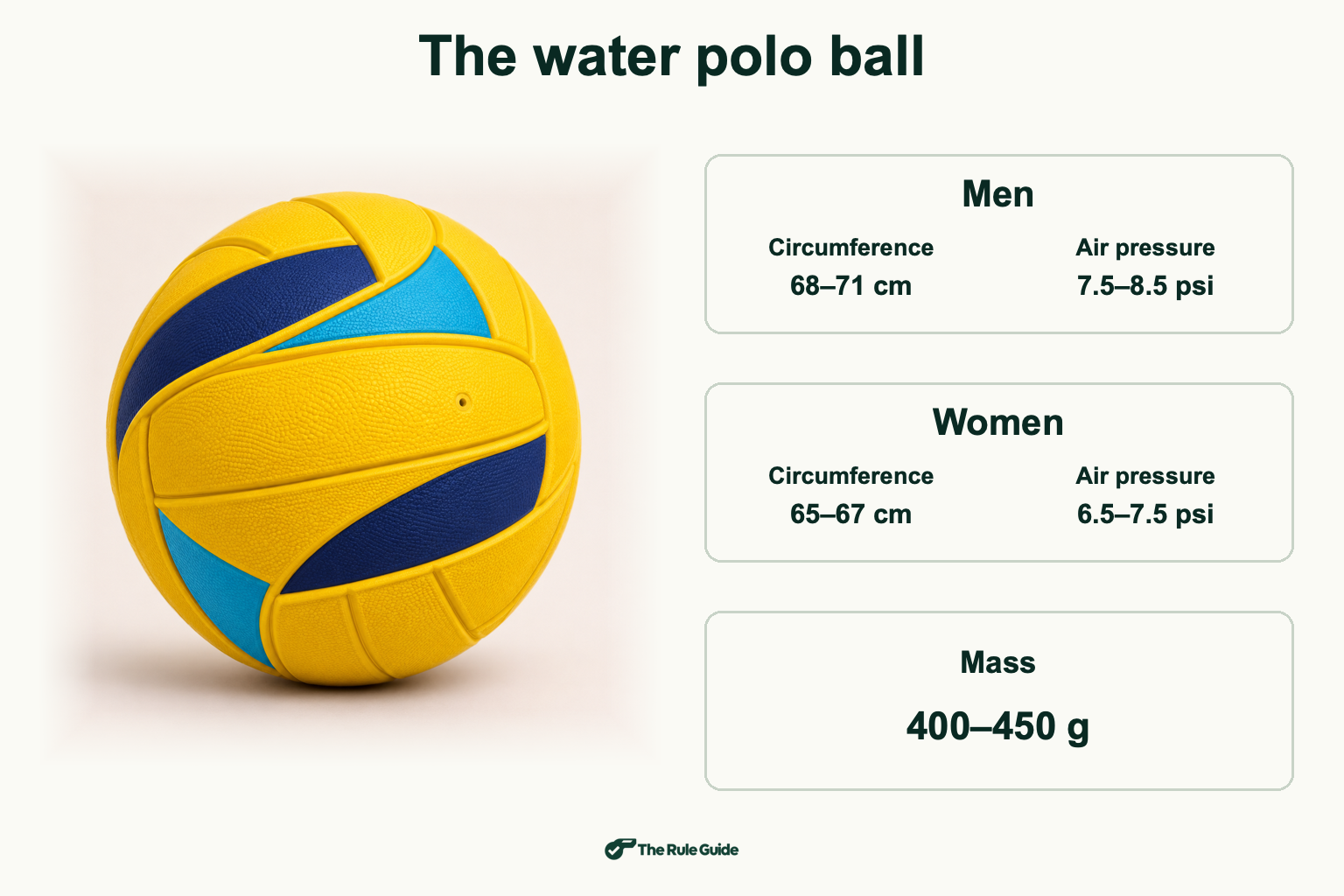
1. Ball and cap
A round waterproof ball has a self-closing valve, no outer straps and no greasy coating. Men use 68–71 cm and 7.5–8.5 psi, women 65–67 cm and 6.5–7.5 psi. Teams wear contrasting caps tied beneath the chin with flexible ear guards. Goalkeepers wear red. The starting keeper wears 1, field players 2–14. Entering play in the wrong cap results in a penalty.
2. Goals and deck
Inside width is 3 m, the underside of the bar is 0.9 m above water and the net extends at least 0.3 m behind the line. White rigid posts and bar are 75–80 mm across. Referee platforms flank both sidelines, 1 m wide and 70 cm above water. Players must remove dangerous items, trim nails and keep oil or grease off their skin. If oil is found after play starts, the player is removed for the game with immediate replacement.
- Posts and crossbar may be wood, metal or plastic. Their front edges align with the front edge of the goal line, and the net encloses the entire space behind. Players and team officials may not use the referee platforms.
3. Caps and match clothing
The first team normally wears white and the second blue, or clearly distinct team colours approved by the referee. An international cap displays the country’s three-letter code, 40 mm high. Numbers appear on both sides. A substitute goalkeeper may wear 2–14 and a third goalkeeper on a permitted list of at least 15 wears 15. Changing cap number needs the referee’s consent and notification to the table. Players wear the correct cap in both substitution areas as well as during play.
- Cap numbers on both sides are 10 mm high. The optional flag is no more than 40 mm high. Ear guards match the cap colour. If colours clash, the second-listed team is normally asked to change.
4. Ropes and poolside equipment
Ropes float on the surface and are 60–120 mm across, at least 100 mm at the Olympics and World Championships. They have tension springs and 12 kN wire. Anchors should withstand 20 kN and protrude at most 10 mm. Each end anchor lies 30 cm behind the goal line. The officials’ table needs a clear view, team benches are in the opposite corners behind the goal lines, and the shot clock should be visible to players and officials.
- If possible use recessed wall anchors. A deck anchor needs a firm, non-stretch extension. The effect on rope length may not exceed 10 mm at either end. Other rope colours require governing-body approval.
Frequently asked questions
Must the referee stop using a ball after a goal?
No. Any number of compliant balls may be used. The assistant referees, or the referees when there are no assistants, manage the match balls.
Does a men's ball have to weigh more than a women's ball?
Both must weigh 400–450 g. The permitted circumference and inflation pressure differ.