
Referee signals
Read the arm movement together with the whistle, direction and cap number.
On this page
1. Restarts and goals2. Exclusion and discipline3. Recognising the offenceFrequently asked questions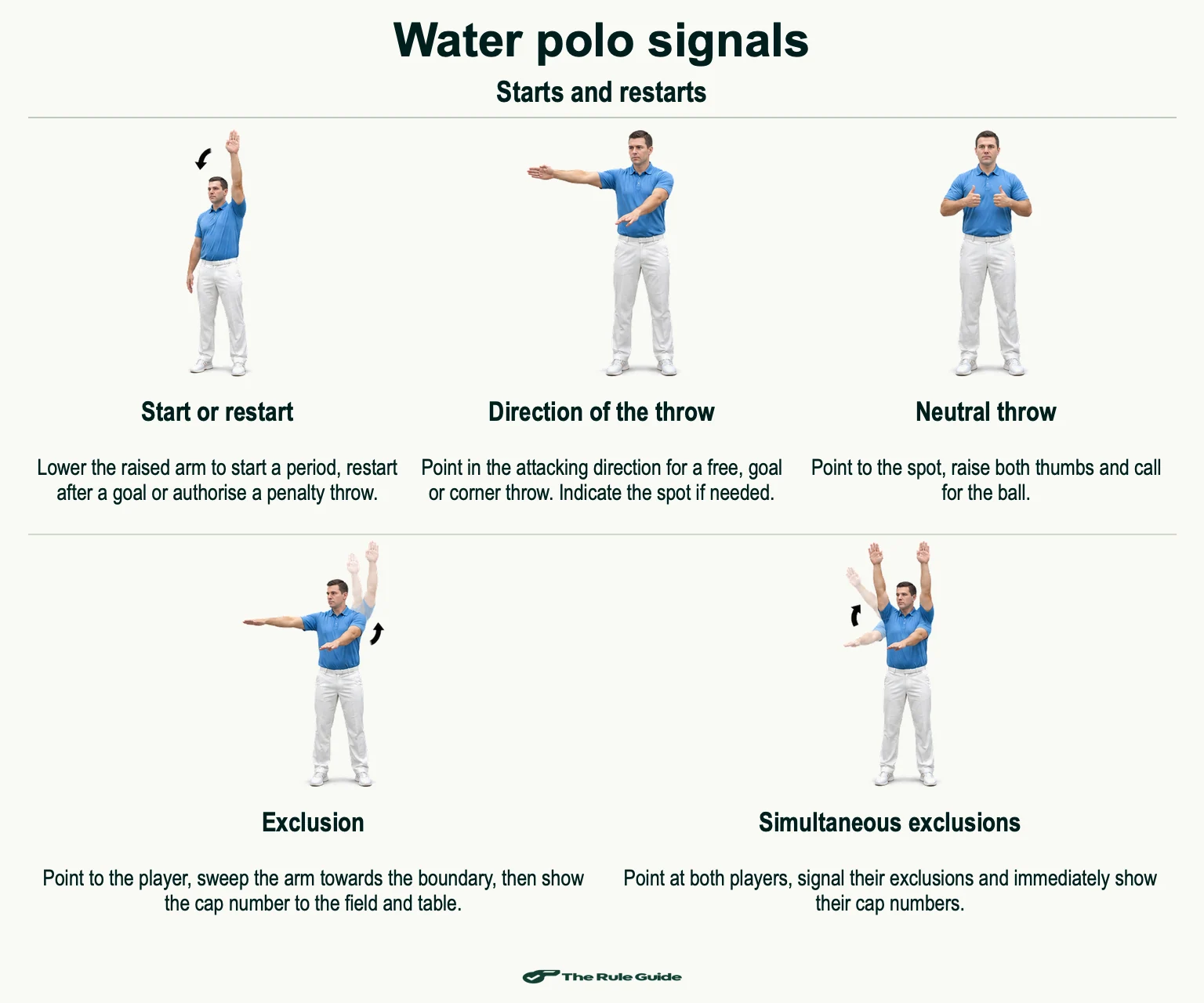
Starts and restarts
- Start or restart — Lower the raised arm to start a period, restart after a goal or authorise a penalty throw.
- Direction of the throw — Point in the attacking direction for a free, goal or corner throw. Indicate the spot if needed.
- Neutral throw — Point to the spot, raise both thumbs and call for the ball.
- Exclusion — Point to the player, sweep the arm towards the boundary, then show the cap number to the field and table.
- Simultaneous exclusions — Point at both players, signal their exclusions and immediately show their cap numbers.
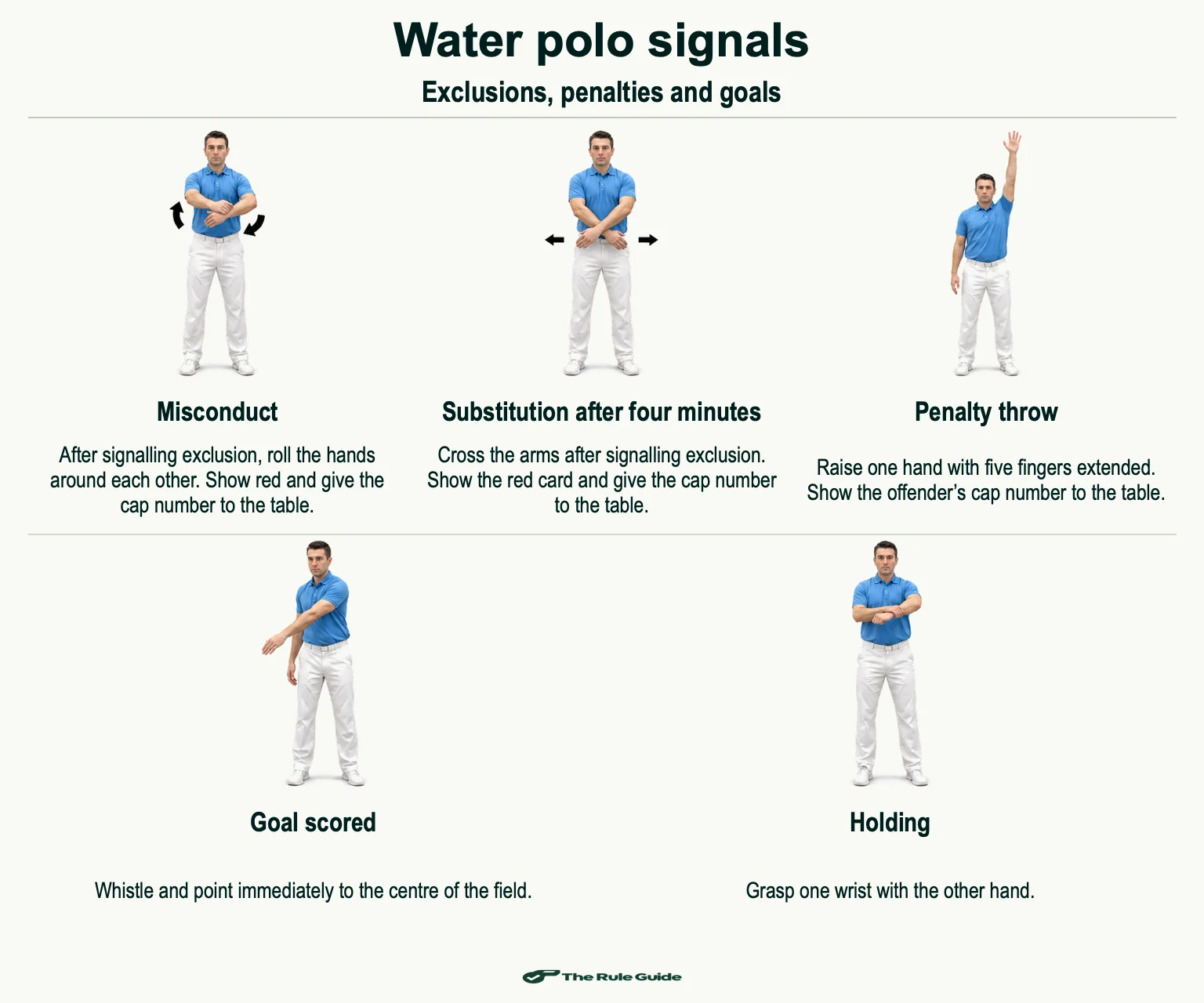
Exclusions, penalties and goals
- Misconduct — After signalling exclusion, roll the hands around each other. Show red and give the cap number to the table.
- Substitution after four minutes — Cross the arms after signalling exclusion. Show the red card and give the cap number to the table.
- Penalty throw — Raise one hand with five fingers extended. Show the offender’s cap number to the table.
- Goal scored — Whistle and point immediately to the centre of the field.
- Holding — Grasp one wrist with the other hand.
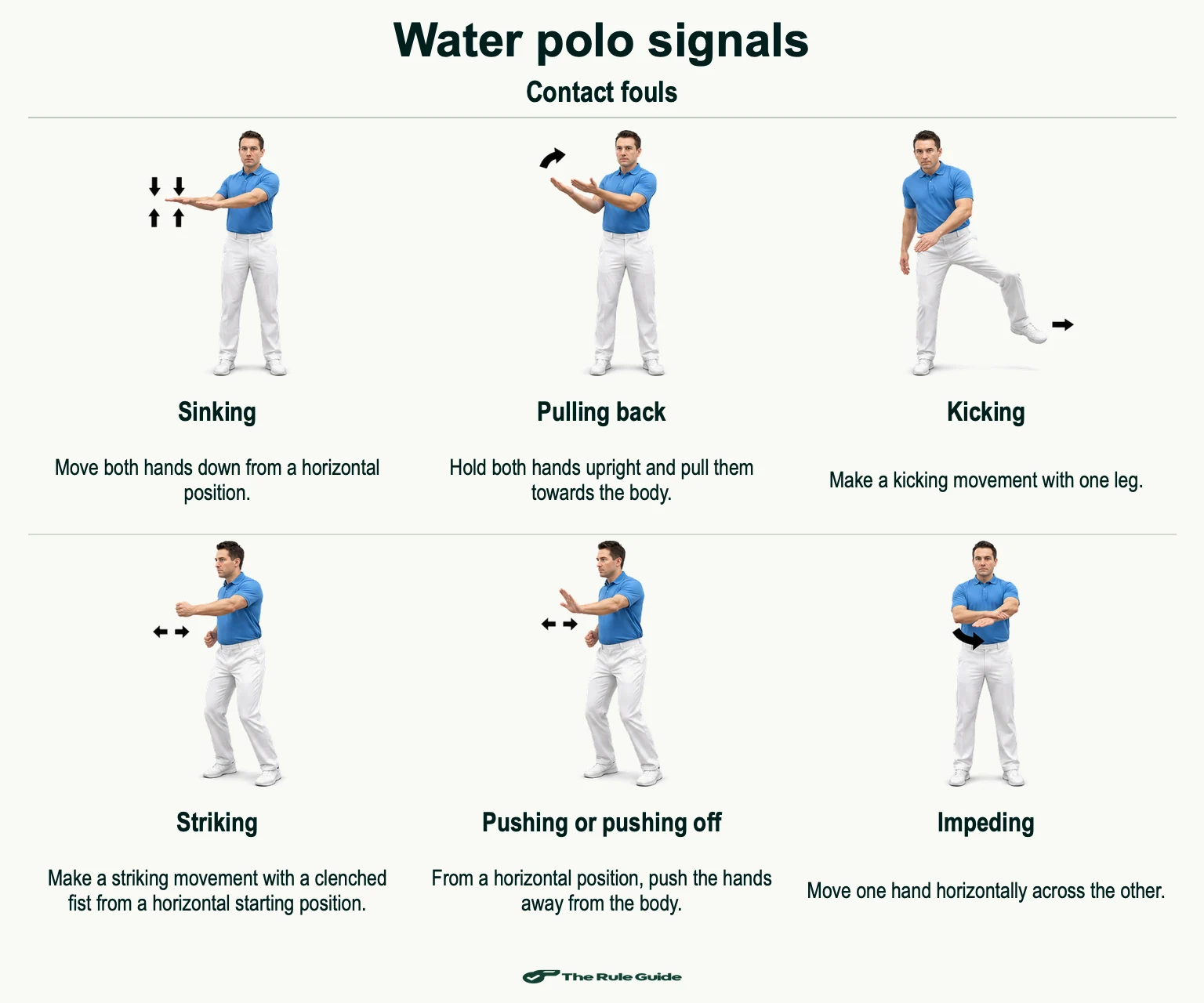
Contact fouls
- Sinking — Move both hands down from a horizontal position.
- Pulling back — Hold both hands upright and pull them towards the body.
- Kicking — Make a kicking movement with one leg.
- Striking — Make a striking movement with a clenched fist from a horizontal starting position.
- Pushing or pushing off — From a horizontal position, push the hands away from the body.
- Impeding — Move one hand horizontally across the other.
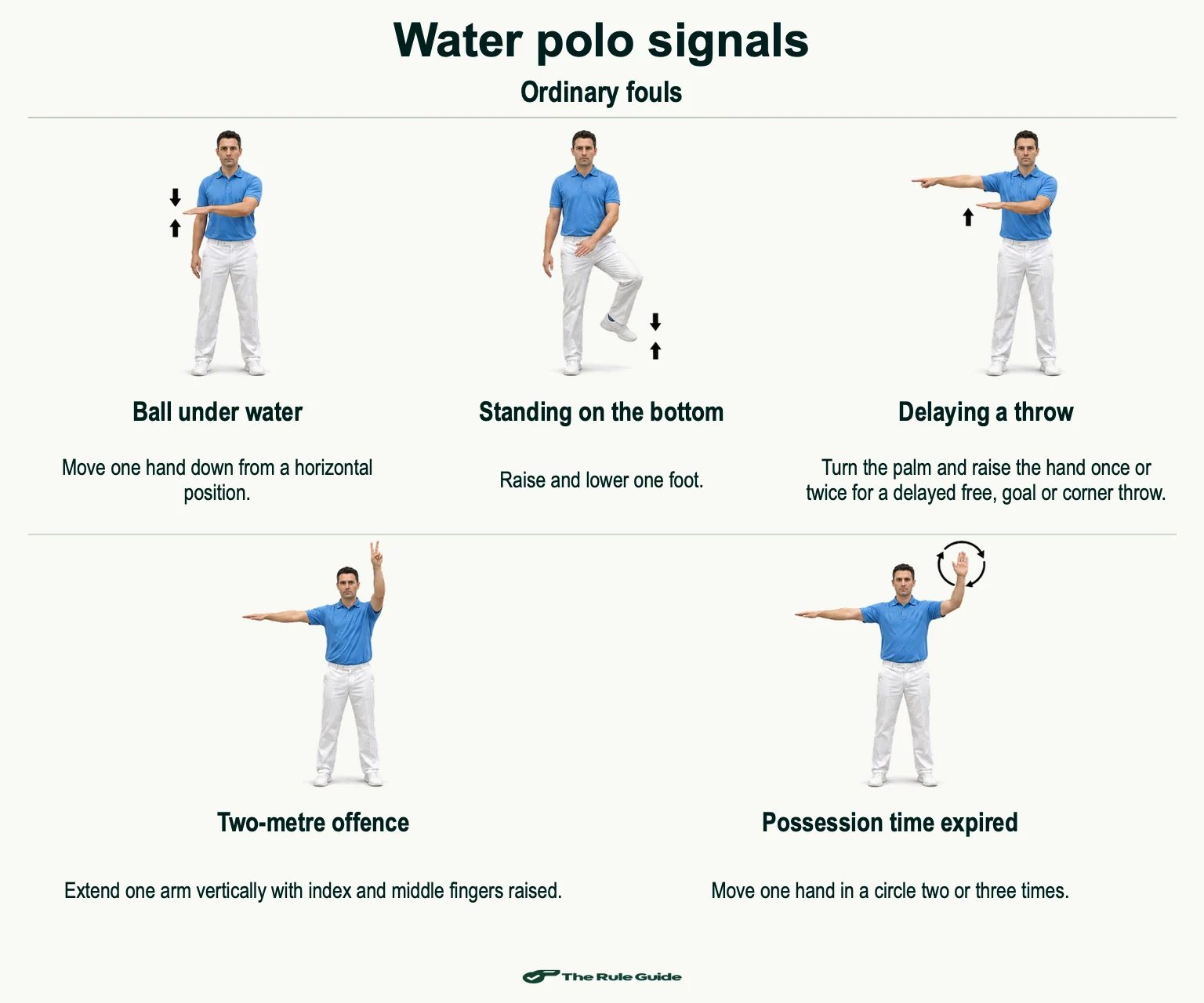
Ordinary fouls
- Ball under water — Move one hand down from a horizontal position.
- Standing on the bottom — Raise and lower one foot.
- Delaying a throw — Turn the palm and raise the hand once or twice for a delayed free, goal or corner throw.
- Two-metre offence — Extend one arm vertically with index and middle fingers raised.
- Possession time expired — Move one hand in a circle two or three times.
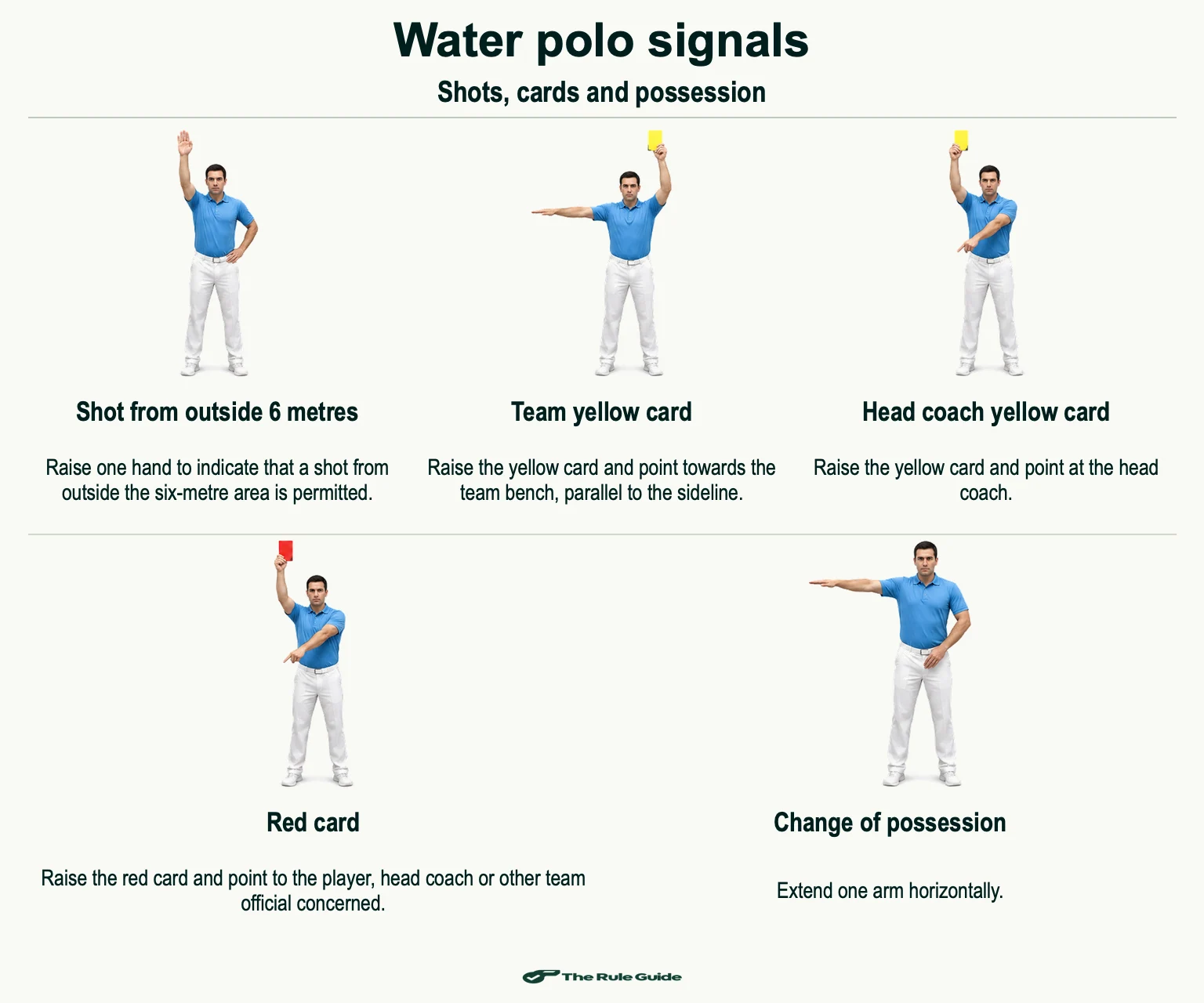
Shots, cards and possession
- Shot from outside 6 metres — Raise one hand to indicate that a shot from outside the six-metre area is permitted.
- Team yellow card — Raise the yellow card and point towards the team bench, parallel to the sideline.
- Head coach yellow card — Raise the yellow card and point at the head coach.
- Red card — Raise the red card and point to the player, head coach or other team official concerned.
- Change of possession — Extend one arm horizontally.
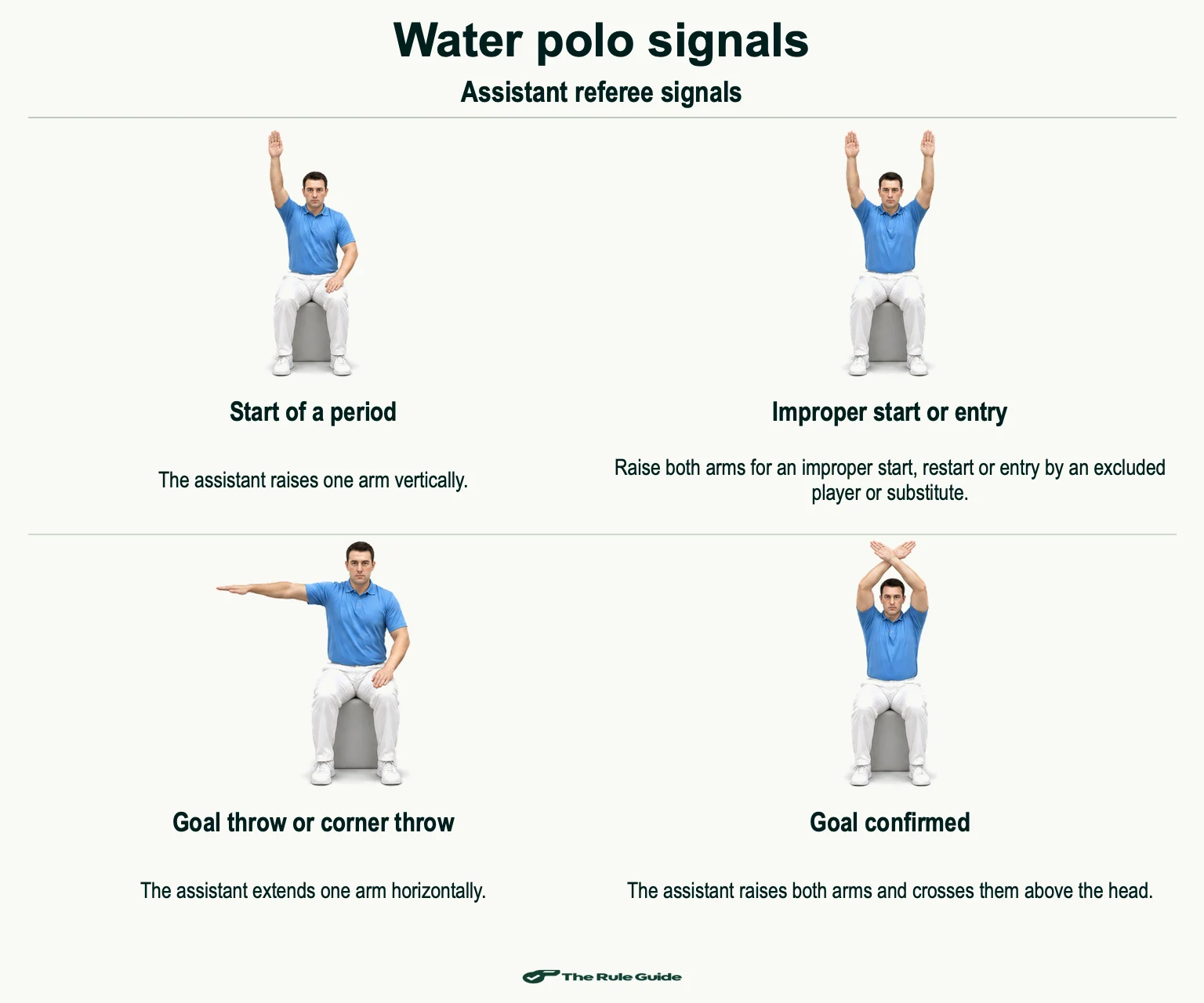
Assistant referee signals
- Start of a period — The assistant raises one arm vertically.
- Improper start or entry — Raise both arms for an improper start, restart or entry by an excluded player or substitute.
- Goal throw or corner throw — The assistant extends one arm horizontally.
- Goal confirmed — The assistant raises both arms and crosses them above the head.
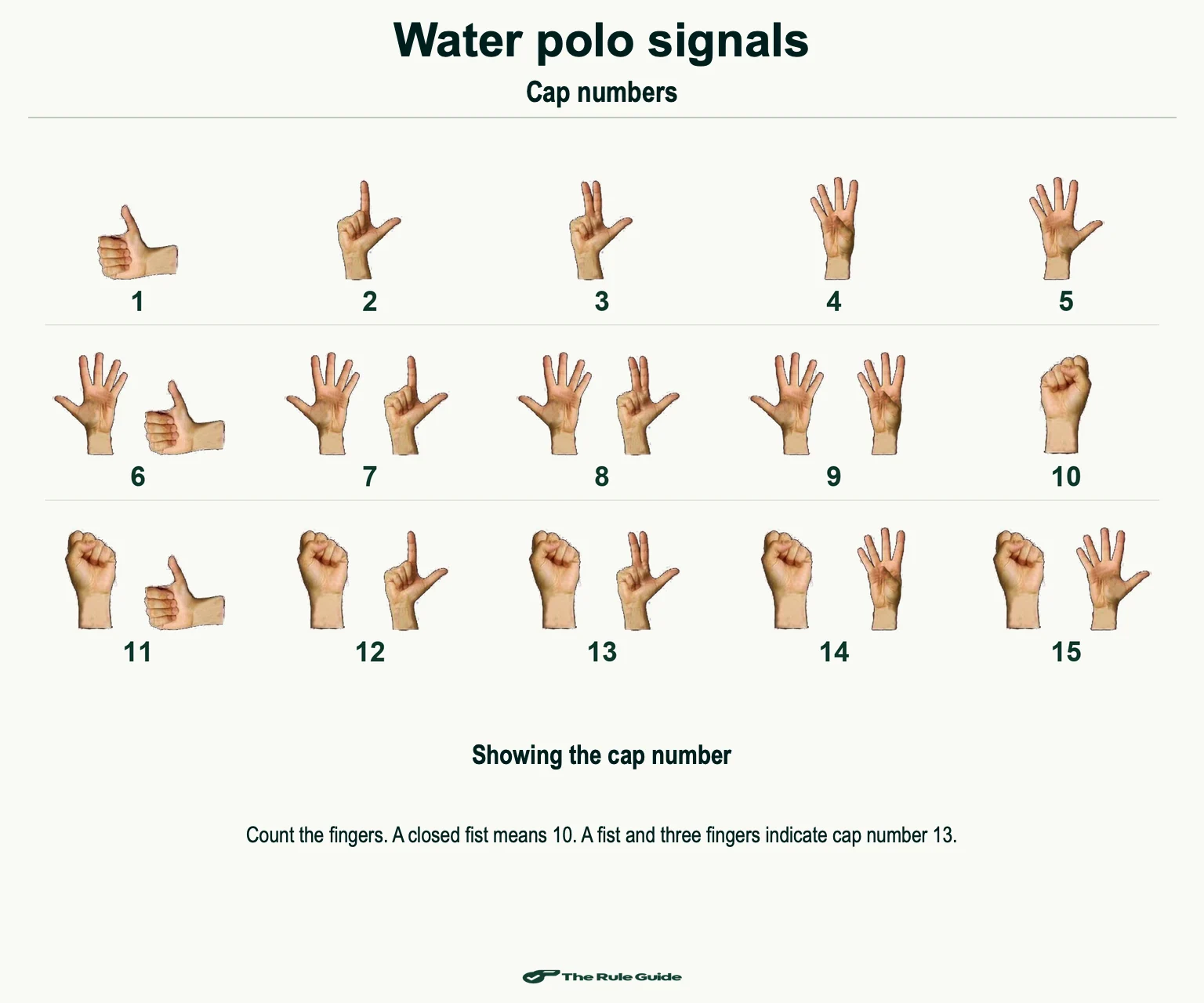
Cap numbers
- Showing the cap number — Count the fingers. A closed fist means 10. A fist and three fingers indicate cap number 13.
1. Restarts and goals
Lowering a raised arm starts a period, restarts after a goal or releases a penalty. For a free throw, goal throw or corner the referee points in the attacking direction and can show the spot with the other hand. Both thumbs up call for a neutral throw. A whistle and a point towards the centre confirm a goal.
2. Exclusion and discipline
The referee points at the offender, sweeps the arm towards the boundary and shows the cap number. For simultaneous exclusions both players are identified. Rotating hands and red indicate misconduct. Crossed arms and red indicate replacement after four minutes. Five fingers overhead award a penalty throw.
3. Recognising the offence
Gripping the wrist means holding. Both hands pressing down mean sinking. Drawing the hands towards the body means pulling back. One hand going down means ball under. Two fingers mean a two-metre offence. Circling the hand signals expiry of possession. The assistant crosses both arms overhead to signal a goal.
Frequently asked questions
How does the table recognise cap 13?
One closed fist represents ten. Three raised fingers on the other hand complete the number.
Does a yellow card aimed at the bench always warn the coach personally?
No. An arm parallel to the sideline pointing towards the bench identifies a team warning. Pointing directly at the head coach identifies a personal warning.